Solitaire
23 games in total. Page 1 of 1


What Is a Free Solitaire Game?
Solitaire is a family of single-player card games played with a standard 52-card deck. The name covers dozens of different rules, but they share one goal: move every card into ordered piles before the deck runs out. The version most people mean when they type "free solitaire game" is Klondike — the seven-column layout that shipped with early desktop computers and never left.
The game is entirely luck-free in the sense that matters: every hand is winnable with the right sequence of moves, and most hands are lost by playing a card too early rather than by a bad deal. That is what makes solitaire worth playing twice. The first game teaches you the rules; the twentieth teaches you to look three moves ahead before touching the stock pile.
On this page you can play solitaire online for free, in full screen, with no download and no account. Undo is unlimited — a bad move costs a click, not a game.
How to Play Klondike Solitaire
Klondike is the layout behind the phrase "classic solitaire." The deal is fixed and the rules are short.
The layout
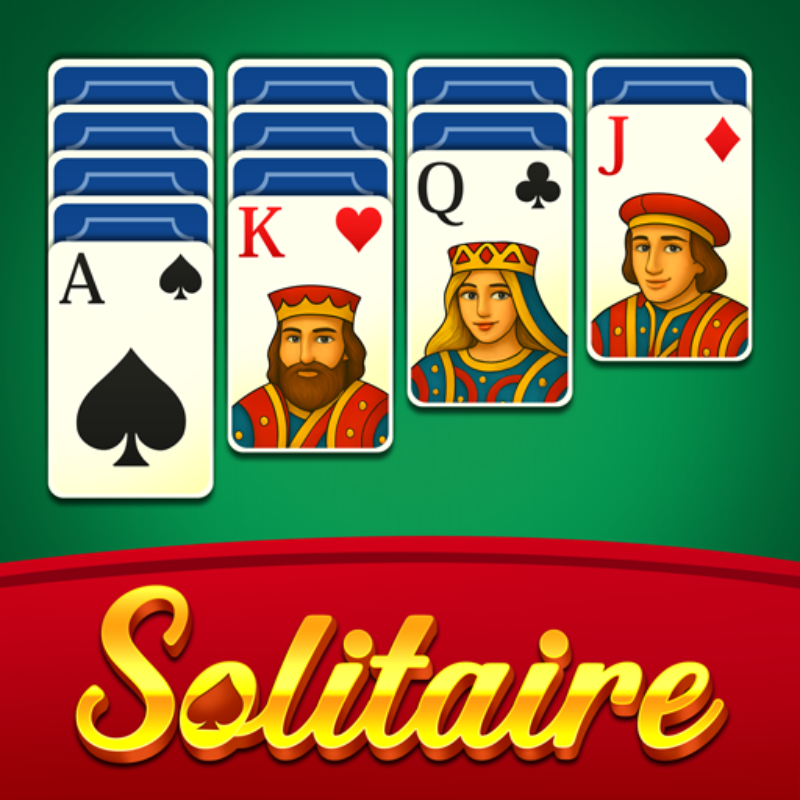
Seven tableau columns are dealt from left to right. The first column receives one card, the second two, the third three, and so on to the seventh. Only the top card of each column is face up; the rest stay hidden until the cards above them are moved.
The remaining 24 cards form the stock pile. Four empty foundation slots sit above the tableau, one per suit.
The moves
- Tableau to tableau. Move a face-up card onto another face-up card that is one rank higher and the opposite color — a red 6 onto a black 7, a black 5 onto a red 6. A whole run of cards can be moved together as long as the run is already in alternating descending order.
- Tableau to foundation. Move an Ace to an empty foundation, then build upward in suit: Ace, 2, 3, and on to King.
- Stock to waste. Turn cards from the stock pile. In Turn 1 you flip one card at a time; in Turn 3 you flip three.
- Empty column. Only a King — or a run starting with a King — may be placed in an empty tableau column.
How to win
The game is won when all four foundations hold a complete suit from Ace to King. When you reach that state, most versions auto-complete the remaining moves.
Turn 1 vs Turn 3 Solitaire
The single setting that changes difficulty most is how many cards you draw from the stock.
Turn 1 draws one card at a time and is the easier setting. It suits people learning the game, or anyone who wants a relaxed hand.
Turn 3 draws three cards at a time and is noticeably harder. It suits experienced players who want the hand to be a puzzle rather than a warm-up.
Turn 3 is harder for a structural reason, not an arbitrary one: with three cards cycling per pass, only every third card in the stock is reachable on a given pass. Turn 1 exposes the entire stock on each cycle, so you can always reach the card you need. Win rates reflect it — Turn 1 hands are winnable far more often than Turn 3 hands from the same shuffle.
If you are unsure which to pick, start with Turn 1 and switch to Turn 3 once you win consistently. The rules do not change between them; only the patience required does.
Solitaire Variants: Spider, FreeCell and TriPeaks
Klondike is one of four solitaire families in this catalog. They differ in deck count, tableau shape and how much information you can see at once.
Spider Solitaire
Spider uses two decks and offers a choice of one, two or four suits. With one suit, every card is the same symbol and the game is mostly about sequencing. With four suits, it becomes a genuine planning problem — you must track four parallel builds while only a few cards are visible.
The tableau in Spider is ten columns, not seven, and the goal is to assemble complete descending runs from King to Ace, which are then removed from the board. You win when the board is empty. See the Spider Solitaire page for the suit-by-suit rules.
FreeCell Solitaire
FreeCell deals all 52 cards face up and adds four "free cells" — temporary holding slots that each take exactly one card. Because nothing is hidden, FreeCell is the most skill-driven of the solitaire games: losing means you misplayed, not that you were unlucky.
Every standard FreeCell deal is theoretically solvable. That is not true of every solitaire variant, and it is why FreeCell has a dedicated following among people who like their card games to be pure puzzles.
TriPeaks and Pyramid
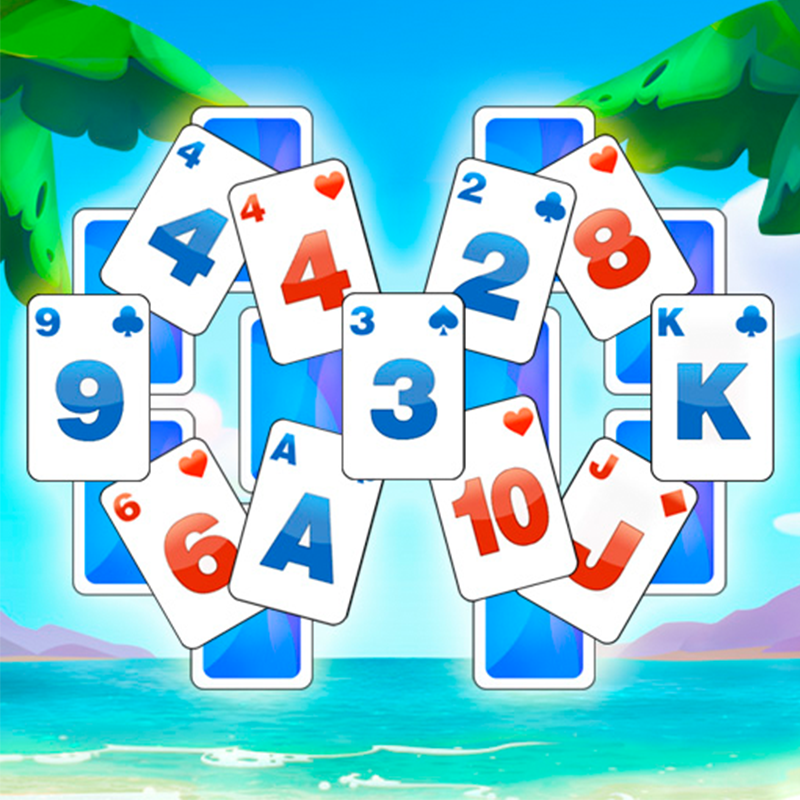
TriPeaks arranges cards in three overlapping peaks that you clear by playing cards one rank above or below the exposed card. Pyramid builds a triangle and asks you to pair cards that sum to thirteen. Neither uses foundations, and both are faster to finish than Klondike.
Solitaire Tips and Strategy
The moves that lose a Klondike hand are usually legal moves made too early. A handful of habits cover most of it.
- Expose hidden cards first. A move that turns over a face-down card is almost always better than a move that does not. Information is the scarce resource in Klondike.
- Do not rush Aces to the foundation. An Ace on the foundation is safe, but a 2 moved up behind it can block a tableau column you still need. Move low cards up only when the tableau does not need them.
- Empty a column deliberately. A free column accepts a King and anything built on it. Clearing one early gives you working room for the rest of the hand.
- Count the stock before you cycle it. In Turn 3, knowing which cards you have already passed tells you whether a wait is worth it.
- Undo before you commit. On this site undo is unlimited. If a move feels wrong, take it back and look for the move that flips a card instead.
- Prefer building on the tableau over building on foundations in the early game. Foundations are one-way; the tableau is where the hand is actually solved.
Solitaire Games for Different Players
Solitaire is unusually broad for a single genre. The right variant depends on what you want from it.
- Learning the rules: Klondike Turn 1. Forgiving, standard, and the layout most guides describe.
- A short break: TriPeaks or Pyramid. A hand takes two or three minutes.
- A real puzzle: FreeCell. Nothing is hidden, so the outcome is on you.
- Long sessions: Spider at four suits. A single game can run twenty minutes.
- Playing with someone: solitaire is single-player by design, but two people can take turns on the same board — a common way to play with a child, since the rules are visible on the table.
Every game here runs in a browser on desktop, tablet and phone. Nothing installs, and no account is needed to play.
Solitaire vs Other Card Games
Solitaire sits next to several other card genres in this catalog, and the boundaries are worth stating.
- Solitaire vs Mahjong. Mahjong uses tiles and matching rules rather than a standard deck and ascending builds. Mahjong Connect adds a line-drawing constraint. Both are single-player and both are relaxing, which is why they get grouped together, but the mechanics share nothing.
- Solitaire vs Match 3. Match 3 is a color-and-shape puzzle with no deck. It has more in common with a jigsaw than with cards.
- Solitaire vs Poker and Blackjack. Those are wagering games against other hands or a dealer. Solitaire has no opponent and no bet; you are solving a layout.
- Solitaire vs Memory games. Memory games ask you to recall where cards were. Solitaire shows you the cards and asks what to do with them.
If you want a card game with an opponent, this catalog's card games page is the better starting point. If you want something with tiles, see Mahjong.
Solitaire FAQ
Is this solitaire really free?
Yes. Every solitaire game on this page is free to play, runs in your browser, and needs no download, install or account. The site is supported by advertising.
Can I play solitaire full screen?
Yes. Use the full-screen control on the game player to hide the rest of the page and play on a larger board. This works on desktop and on phones in landscape.
What is the difference between solitaire and Klondike?
Klondike is one solitaire variant — the seven-column layout most people mean by "solitaire". "Solitaire" also covers Spider, FreeCell, TriPeaks and dozens of others.
Why do I keep losing at solitaire?
Most losses come from moving cards to the foundation too early or from cycling the stock before checking the tableau. Expose hidden cards first and keep the tableau flexible.
Is solitaire a game of luck or skill?
Both, in a fixed proportion. The deal is random, but most winnable hands are lost to misplays. Skilled players win noticeably more often from the same shuffles.
Can I play solitaire without downloading anything?
Yes. All the solitaire games here are browser games. Nothing downloads and nothing installs — the game loads from the page itself.
Does solitaire work offline?
Once a game has loaded in your browser it keeps running if the connection drops. Loading a new game needs a connection.
Is Spider Solitaire harder than Klondike?
Usually yes. Spider uses two decks and ten columns, and at four suits it demands far more planning. Start with one suit to learn the sequencing.