
Mahjong
32 games in total. Page 1 of 1














What Is Mahjong Connect?
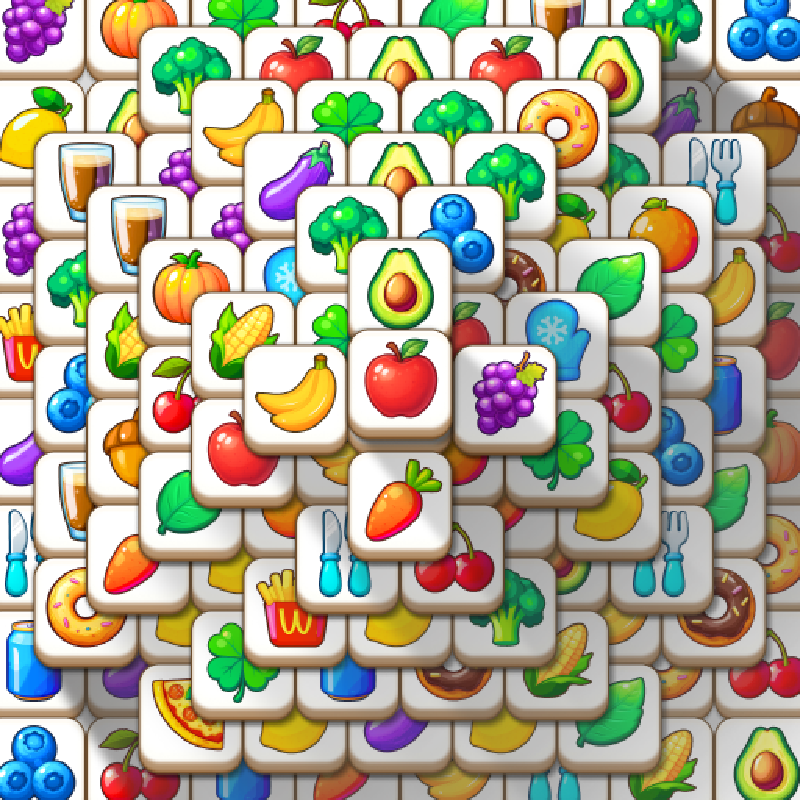
Mahjong Connect is a tile-matching puzzle. A board of Mahjong tiles is laid flat, two of every symbol, and you remove pairs by drawing a line between two identical tiles. The line may bend, but only twice — that is the whole rule, and every decision in the game follows from it.
The name is confusing, so it is worth stating plainly: Mahjong Connect is not the four-player Mahjong card game. There are no Winds and no Dragons being collected, no wall being drawn from, no discard pile, no opponents and no scoring hands. It borrows the tiles and nothing else. Nobody at this page is playing Mahjong; they are playing a matching puzzle that happens to be drawn on Mahjong tiles.
On this page you can play Mahjong Connect games online for free, in full screen, with no download and no account.
How Mahjong Connect Rules Work
The rules take a paragraph to learn and a lifetime to stop misreading.
Match two identical tiles
Only identical tiles pair. An identical pair means the same face — same symbol, same number, same color. Two different tiles that look similar do not connect, and the game will not accept them.
Connect with at most two turns
This is the constraint that defines the genre. Imagine a line drawn from the center of one tile to the center of the other. That line may travel through empty space, and it may change direction at most twice. Three turns is not allowed, even when the path would be shorter.
A pair with a clear straight line between them — no turn at all — is always available. A pair that needs one turn is available if the corner square is empty. A pair that needs two turns is available only if both corner squares are empty. Everything else is a "no".
Use the outside of the board
A line may pass around the outer edge of the layout, outside the tile field itself. That escape route is the reason so many pairs that look impossible are actually legal: the path leaves the board on the left, travels along the outside, and comes back in on the right. New players miss this for their first three boards.
Clear the board to win
The board is cleared when no tiles remain. If tiles remain and no legal pair exists, the game is stuck. Most versions offer a shuffle, a hint or a restart, and most put a timer on the board to stop you from staring at it forever.
Mahjong Connect vs Mahjong Solitaire
These two get grouped together constantly, and they are genuinely different games, not two names for one.
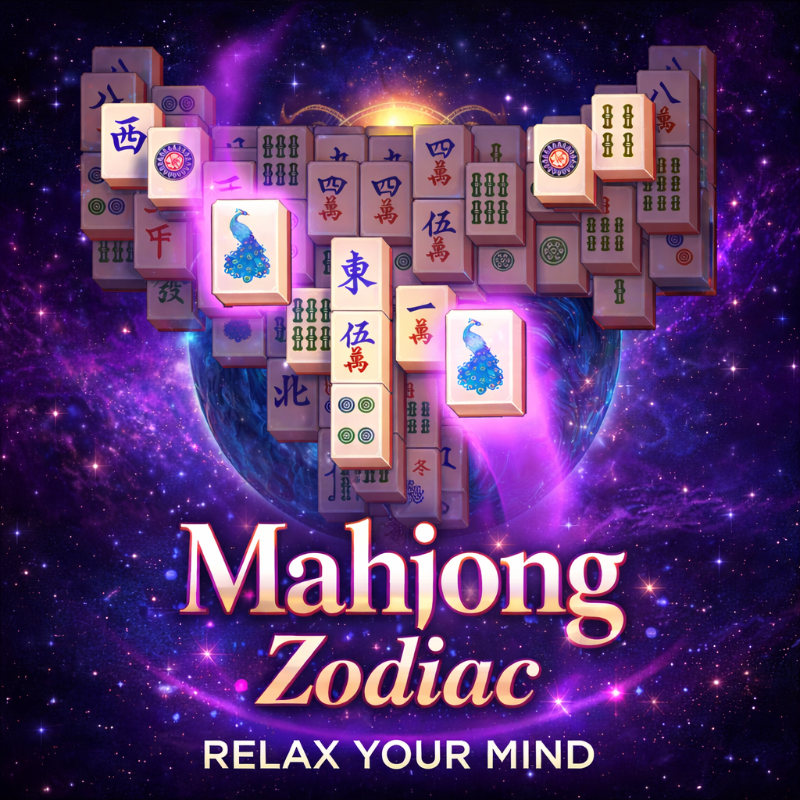
Mahjong Solitaire stacks tiles in layers: a pyramid with tiles on top of tiles. You remove pairs, but the rule is about freedom, not lines. A tile is selectable when it has no tile on top of it and at least one free side. Depth and blocking are the puzzle. The classic 144-tile turtle layout is the shape most people picture when they say "Mahjong".
Mahjong Connect flattens the same tiles into a single layer and replaces the freedom rule with the line rule. Nothing is stacked, so nothing is blocked by height; instead the constraint is geometric. A pair is legal or it is not, and you can see why.
The practical difference for a player:
- Mahjong Solitaire asks you to plan which tiles to free. Order matters, and a wrong early move can bury a pair permanently.
- Mahjong Connect asks you to read the board. Order matters less; the question is which pairs are currently connected.
Both formats are easy to confuse from a list of tiles, so it helps to know which one you are clicking. For deck-based card games instead of tiles, the solitaire page covers the classic variants. If you want flat tiles and lines, keep reading.
Classic Mahjong Connect Layouts and Levels
Level design in Mahjong Connect is mostly about density. The rules never change; the board does.
- The full rectangle. The first board most players meet: an even grid, all tiles present, generous outside access. It teaches the two-turn rule because early moves are easy and the last ten tiles are not.
- Diamond and cross shapes. Tiles are arranged so that the center is dense and the corners are sparse. The outside route becomes essential rather than optional.
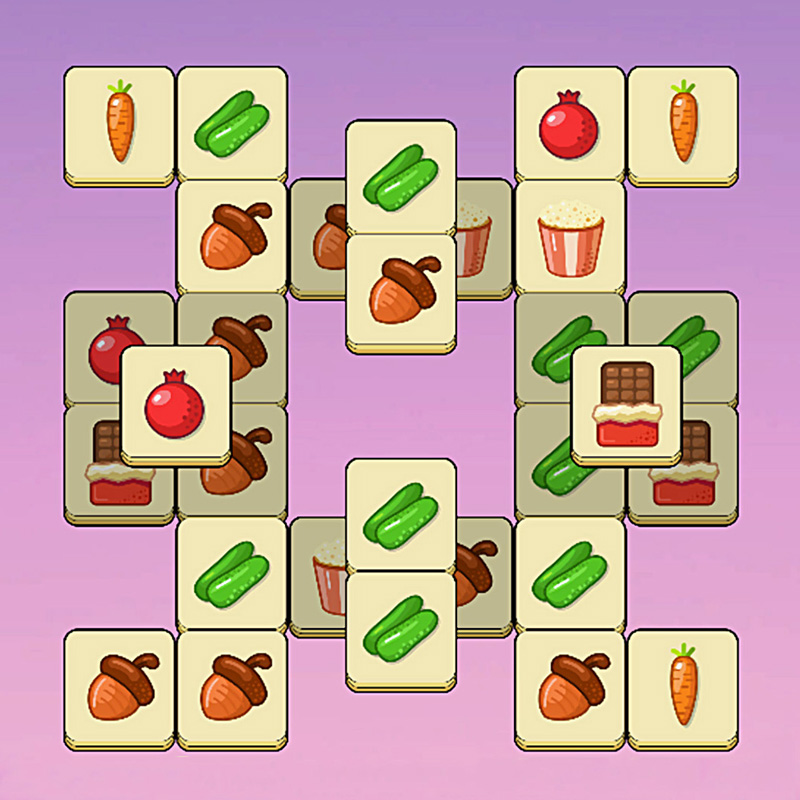
- Hollow frames. The middle of the board is empty from the start. Pairs across the gap need two turns immediately, so the puzzle is available from move one.
- Layered-looking flat boards. Some layouts draw tiles in a pattern that looks stacked but is not. The confusion is deliberate and it is the best training for the line rule.
- Progressive levels. Many games here run a ladder: each board adds tiles, narrows the outside route, or shortens the timer. The last board of a set is usually a dense rectangle with almost no clear lines.
The board size grows across a level set, and so does the cost of a bad read. What separates an easy board from a hard one is not the number of tiles but the number of legal pairs at any moment.
Mahjong Connect Strategy: Clear the Edges First
A few habits will get you through boards that look impossible.
- Work the outer ring first. Tiles on the edge have more legal paths than tiles in the middle, because they are one step closer to the outside route. Clearing them opens lines inward.
- Prefer pairs that free a corner. A corner tile is a turning point for every two-turn path that passes it. Removing one can convert a dozen blocked pairs into legal ones.
- Remove pairs that only have one path. If a pair has exactly one legal connection, take it before something else changes the board. A pair with six paths can wait.
- Look outside the board before declaring a pair impossible. Trace the line around the perimeter. Many "no" answers are "yes" once you leave the tile field.
- Do not burn hints early. Hints are usually limited. Spend them on the last twenty tiles, when the board is sparse and the paths are subtle, not on a full board where half the pairs are obvious.
- Check the clock, then ignore it. A timer rewards speed, but a wrong pair rarely costs less than three seconds of thinking. Clear boards are won by reading, not by clicking fast.
The single most common mistake is treating Mahjong Connect as a memory game. It is not. All information is on the board at all times — the skill is in seeing which lines exist, not in remembering where a tile was.
Why Mahjong Connect Is Easier Than Real Mahjong
The comparison is unfair to Mahjong, but it explains why this format is so popular.
- No rules to learn. Four-player Mahjong has a scoring system, a wall, seat winds, calls, and a hand limit that takes an evening to understand. Mahjong Connect has one rule: identical tiles, two turns.
- No opponents. There is nobody to read, no discard pile to track and no bluffing. The board is the only opponent, and it does not hide anything.
- A session fits in a break. A board takes two to ten minutes. A Mahjong hand takes as long as four people take.
- Failure is cheap. A stuck board costs a restart. A lost Mahjong hand costs the round.
- It is single-player by design. You can play it on a phone in a queue without explaining anything to anyone.
That is also the honest limit: Mahjong Connect has no depth of competition. It is a puzzle, and it is a good one. If you want the actual tile game with four seats and a wall, this is not that page and this site does not carry it.
Choosing a Mahjong Game Here
The games on this page differ mostly in shape, timer and level structure, so the choice is simple.
- First time: a full rectangle board with no timer, or a timed one on the gentlest setting. Learn the two-turn rule on a board that does not punish you.
- A short break: any level set's first board. Two or three minutes.
- A real puzzle: a hollow frame or cross layout on a later level. These have the fewest legal pairs per tile.
- Playing with someone: Mahjong Connect is single-player, but two people can read the same board and take turns calling pairs — a good way to play with a child, since the rule is visible on the screen.
- Something adjacent: match 3 games for color-matching with cascades, puzzle games for logic, or arcade games if you want reflexes instead of reading.
Every game here runs in a browser on desktop, tablet and phone, with no download and no account.
Mahjong FAQ
Is Mahjong Connect the same as Mahjong?
No. Mahjong Connect is a single-player tile-matching puzzle. The four-player Mahjong card game has a wall, discards, opponents and scoring hands. Connect borrows only the tile artwork.
How many turns can a Mahjong Connect line have?
At most two. A straight line has zero turns, a single corner has one, and an L-shaped path has two. Three turns is never allowed, even if the path would be shorter.
Is Mahjong Connect the same as Mahjong Solitaire?
No. Mahjong Solitaire stacks tiles in layers and selects tiles by whether they are uncovered and free on one side. Mahjong Connect uses one flat layer and selects tiles by whether a line with two turns can join them.
Can a Mahjong Connect line go outside the board?
Yes, and this is a core rule. A line may leave the tile field, travel around the outer edge and re-enter. Many pairs that look blocked are legal through the outside route.
What happens when no pairs are left?
The board is stuck. Most versions offer a shuffle, a limited number of hints, or a restart. Restarting is free and costs only the time already spent.
Are these Mahjong games free and full screen?
Yes. Every game on this page is free, runs in the browser and can be played full screen. Nothing downloads and no account is needed.
Why can I not match two tiles that look identical?
Either the tiles differ in a detail you missed, or the path between them needs more than two turns. Check the corners of the proposed path, and check the route around the outside of the board.
Does Mahjong Connect work on a phone?
Yes. The games are built for touch and play well in portrait or landscape. Boards are small enough to read on a phone screen, and tapping replaces the mouse.