
Match 3
64 games in total. Page 1 of 2













What Are Match 3 Games?
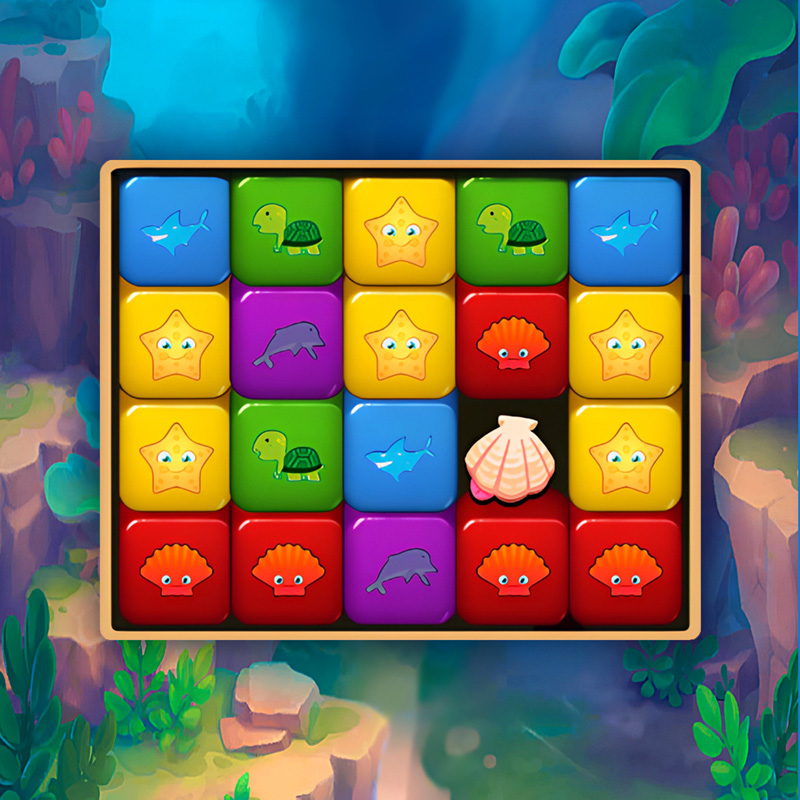
Match 3 games are tile puzzles built on one rule: swap two adjacent pieces so that three or more of the same color or shape line up, then those pieces disappear and the board falls to fill the gaps. The rule takes one sentence; the games built on it run for two decades.
The genre's appeal is that it is legible. Nothing is hidden, the board is fully visible, and a move either works or does not. That makes match 3 the most approachable of the tile genres — easier to pick up than Mahjong Connect, and far easier than a four-suit solitaire hand — while still offering enough depth to hold attention across a long session.
Every match 3 game here runs in your browser. No download, no install, no account.
How to Play Match 3 Games
The core loop is identical across the genre, with variations layered on top.
- Scan the board for existing pairs. Two tiles of one color separated by a single different tile is a one-swap match. These are always the safest moves.
- Swap and clear. When three or more align, the tiles vanish. Everything above drops down, and new tiles enter from the top.
- Chain your matches. Most games award bonus points, extra moves or power-ups for matches that land immediately after a previous clear, before the board settles. Chaining is where the score is actually made.
Special tiles
Most match 3 games generate a special piece when you clear four, five, or an L or T shape:
- Four in a row usually creates a striped or directional tile that clears an entire row or column when matched.
- Five in a row typically produces a color bomb that removes every tile of one color.
- L and T shapes produce an area-effect tile that clears a block around itself.
Combining two special tiles is usually far more powerful than using either alone — swapping a striped tile into a color bomb, for instance, clears the whole board. Learning which combinations your specific game supports is the fastest route from beginner to competent.
Move limits and objectives
Two failure modes exist. Some levels give you a fixed number of moves and ask you to clear an objective — a target score, a number of specific tiles, or a section of the board covered in an obstacle. Others run on a timer. The strategy differs: with a move limit every swap must count, while a timer rewards speed over precision.
Match 3 Variants and Types
Not every tile puzzle uses the same rule set, and knowing the sub-types helps you pick the right game.
Classic swap match 3. The original form. You swap adjacent tiles and the board refills. Levels are objective-based, often with blockers that need clearing.
Match 3 with story progression. The swap mechanics are unchanged but levels are framed as chapters — renovating a house, restoring a garden. The story does not change the puzzle; it changes the pacing.
Collapse and cascade games. You do not swap; you tap a cluster of three or more and the board collapses. Slower and more deliberate than swap match 3, closer to a solitaire rhythm.
Match 2 and pairing games. These clear pairs rather than triples and are frequently confused with match 3. They belong with matching games, where partner-finding is the core mechanic rather than the side effect.
Merge games. You combine two of the same piece into a single upgraded piece rather than clearing it. Mechanically adjacent to match 3 and worth exploring if you like the "combine identical things" loop — see merge games.
Match 3 Tips and Strategy
The genre looks like a color-matching reflex test. It is actually a planning exercise, and the difference is visible in scores.
- Work from the bottom of the board. Clearing tiles near the bottom causes more of the board to fall, which generates more accidental cascades than clearing at the top.
- Do not chase every legal match. A move that clears three in a corner may be worse than one that sets up a four-in-a-row elsewhere. Look for the move that creates a special tile.
- Build specials before you need them. A color bomb saved for a difficult objective is worth more than the three-tile match you could have used it on.
- Read the objective before your first move. Clearing the target tiles matters more than the score. Many levels are lost by optimising for points rather than for the goal.
- Watch the tiles you need, not the ones you can clear. If the objective asks for 40 blue tiles, deliberately avoid clearing blue clusters until you can clear several at once.
- Undo is unnecessary; restart is free. If a board starts badly, restarting costs nothing. The first three moves usually determine whether the level is winnable.
Match 3 Games for Different Players
The genre is broad enough to suit several kinds of player.
- Short breaks: classic objective levels. A board finishes in two to four minutes.
- Long sessions: story-progression match 3, where chapter pacing gives a reason to keep going.
- Children: match 3 is one of the easiest tile genres to teach — the rule is visible on the board, and no reading is required. See games for kids.
- Puzzle purists: collapse-and-cascade variants, which remove the reflex element and leave only planning.
Everything here plays on desktop, tablet and phone, with no installation and no account.
Common Match 3 Objectives and Obstacles
Beyond the swap rule, nearly every match 3 level is built from a small kit of goals and blockers. Knowing the vocabulary makes an unfamiliar game readable within a minute.
Score targets. Reach a number before moves run out. The easiest objective and the one most often paired with a move limit.
Collect specific tiles. Clear forty of one color, or twenty of a shape. These are won by restraint: clearing the target color everywhere means it never clusters, so you clear them slower.
Break blockers. Ice, chains, jelly and crates cover tiles and require a match on or beside them to remove. Layers usually stack — a double-iced tile takes two adjacent matches.
Drop items to the bottom. Some games place a token in a tile that must fall off the bottom edge. Clearing beneath it is the whole strategy; clearing above it does nothing.
Clear the board of one obstruction type. Spread-out objectives reward board-wide specials over local matches.
The practical consequence: read the objective before the first move. A player optimising for score on a collect-objective level will lose with a high score, which is the most common way these levels are failed.
Match 3 Power-Up Combinations
Special tiles combine, and the combinations are where the highest-value moves live. The list below covers what most games in the genre implement; the exact squares differ per title, but the pattern is consistent.
- Striped plus striped. Clears both the row and the column, a cross-shaped wipe.
- Striped plus color bomb. Converts every tile of one color into striped tiles, then clears them all. Usually the largest single move in the game.
- Color bomb plus color bomb. Clears the entire board.
- Wrapped plus striped. A three-row, three-column blast.
- Wrapped plus color bomb. Clears every tile of one color twice, which is often enough to finish a collect objective in one move.
Building a combination takes two moves you could have spent on ordinary matches. On a move-limited level that is a real cost, and the calculation is whether the combination saves more moves than it costs. Usually it does — but not on a short 15-move level where every swap is precious.
Match 3 on Mobile and Desktop
The genre is built for touch, and the difference between a phone and a desktop is smaller here than in most categories.
Touch. Swapping by dragging is natural, and boards are sized so that a thumb can reach the middle. On a phone, portrait orientation usually shows the whole board.
Mouse. Clicking to select and then clicking to swap is slower than dragging but more precise, which matters on levels with a move limit.
Keyboard. Rare in the genre. Where supported, it is usually arrow keys to move a cursor and a key to pick up and drop.
A practical note: the board has to be fully visible for the game to be playable at all. If a phone layout crops the grid, the game is unplayable regardless of how good the mechanics are — close the browser's zoom and play in landscape if the game offers it.
Match 3 vs Other Tile and Puzzle Games
Match 3 sits in a crowded part of the catalog, and the boundaries are worth stating plainly.
- Match 3 vs Mahjong Connect. Mahjong asks you to pair identical tiles connected by a clear line with at most two turns; match 3 asks you to align three or more by swapping. Both are tile games, neither is a card game, and the planning skills overlap — but the failure states are different.
- Match 3 vs Memory games. Memory games hide the board and ask you to recall it. Match 3 shows everything and asks what to do next.
- Match 3 vs Solitaire. Solitaire is a card build. The only real similarity is that both are single-player and both reward looking ahead.
- Match 3 vs Puzzle games broadly. Puzzle covers jigsaws, physics puzzles and brain teasers. Match 3 is one specific mechanic inside that larger family — see puzzle games.
Match 3 FAQ
Are these match 3 games free?
Yes. Every match 3 game on this page is free to play in your browser, with no download, no install and no account required.
What is the difference between match 3 and match 2?
Match 3 clears three or more tiles in a row by swapping adjacent pieces. Match 2 clears pairs and usually does not involve swapping — it belongs with matching games rather than match 3.
How do I get a color bomb in match 3?
Usually by lining up five tiles in a row. The exact rule varies per game, but five-in-a-row almost always produces the strongest special tile.
Why do I run out of moves in match 3?
Most levels give a fixed move budget and ask you to complete an objective. Spending moves on point-scoring rather than on the objective is the usual cause.
Can I play match 3 without downloading anything?
Yes. All the games here are browser games — nothing downloads or installs, and the game loads directly from the page.
Is match 3 good for children?
Generally yes. The rule is visible on the board and needs no reading, which makes it one of the easiest tile genres for young children to pick up.
What is a cascade in match 3?
A cascade is an additional match created when tiles fall into place after a clear. Most games award bonus points for chaining cascades.
Do match 3 games work on a phone?
Yes. The boards are built for touch, and swap controls work by tapping or dragging. They scale to phone screens without losing board visibility.