Memory Games
7 games in total. Page 1 of 1
Memory games ask you to remember where cards are and match pairs. They are used with young children to build concentration and visual recall.


What Are Memory Games for Kids?
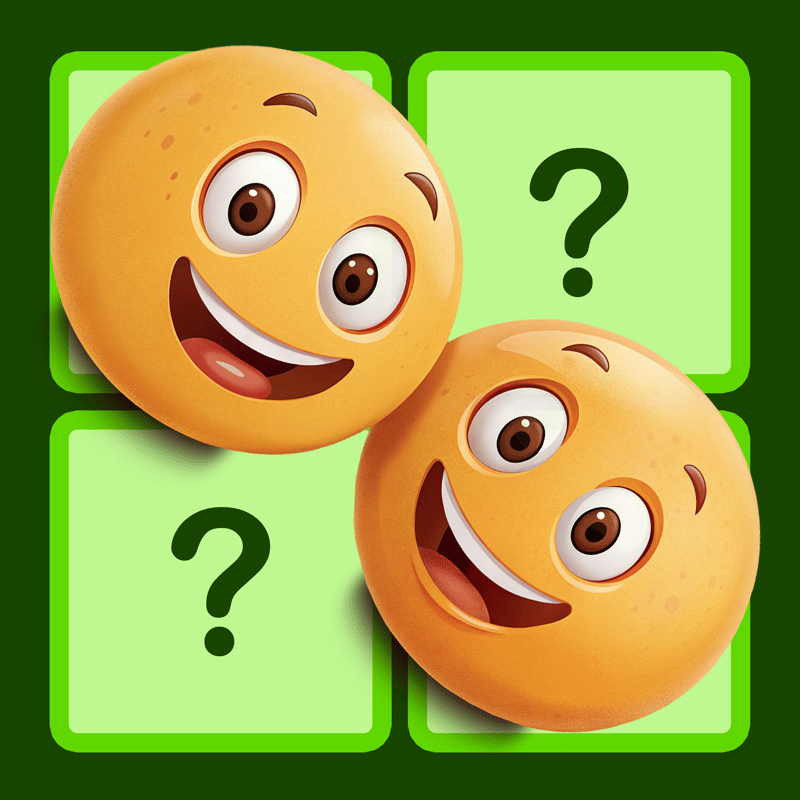
Memory games are card-flipping games. A set of pairs is laid face down, and you turn two cards at a time. If they match, they stay open; if not, they flip back and the next player takes a turn. The whole game is one skill: remembering where a card you have already seen is sitting.
That simplicity is why memory games work so well with young children. There is no reading, no arithmetic and no rule that has to be explained twice. The board holds all the information, and the challenge is paying attention to it — which is exactly the capacity that early-years educators want to build.
Every memory game here runs in a browser. No download, no install, no account, and no in-game purchases.
How to Play Memory Games
The rules take under a minute to learn and a lifetime to get good at.
- Lay out the cards. A memory game uses an even number of cards — often 12, 16 or 24 — arranged in a grid, all face down.
- Turn two cards. On your turn, flip any two cards so everyone can see them.
- Keep a matching pair. If the two cards match, they are yours and stay face up. You usually get another turn immediately.
- Flip back a mismatch. If they do not match, both cards turn face down again and play passes to the next person.
- Win by collecting pairs. The game ends when every pair has been claimed. The player holding the most pairs wins.
One player or two
Memory works just as well alone. Single-player memory is effectively a recall drill: the objective is to finish the board in the fewest moves or the shortest time, and most digital versions track both. Two-player memory adds a competitive layer — every pair your opponent collects is a pair you cannot see again unless you were watching their turn.
Memory Games by Age
The right board size depends almost entirely on the child's age, and giving a four-year-old a 24-card grid is the fastest way to make them dislike the game.
Ages 3–4. Six pairs (12 cards). At this age the game is mostly about turn-taking and naming what is on the card. Use picture cards rather than abstract symbols. Expect the child to remember two or three positions, not the whole board.
Ages 5–6. Eight to ten pairs. This is when genuine recall strategies start to appear — the child begins deliberately rehearsing "the cat is in the top right corner". Sixteen cards is a comfortable ceiling.
Ages 7–9. Twelve pairs and up. Children at this age can hold a mental map of the board and will start tracking pairs their opponent has revealed. Two-player games become genuinely competitive here.
Ages 10+ and adults. Full boards, timed runs, and themed sets with many similar-looking cards. Difficulty comes from visual similarity rather than board size.
Memory Games for 2 Players
Two-player memory is one of the few genuinely equal games you can play with a young child. The board does not care who is older, and an adult who tries to win every turn will find a well-played six-year-old hard to beat.
A few notes on making it work:
- Play with a board sized to the younger player. A 12-card board lets both players see most of it, which keeps the game close.
- Narrate your turns. Saying "I remember the red fish was here" out loud teaches the strategy by example — and is the whole point of the game.
- Decide the tie rule in advance. Many memory games end level. Agreeing beforehand whether a draw is a draw, or whether one more round settles it, avoids the argument.
- Take turns rather than racing. Racing versions exist, but for young children turn-taking is the more useful skill.
Memory Games for Adults
Adult memory games are harder than the children's version in one specific way: the cards look alike. Where a child's board uses a cat, a boat and a cake, an adult board might use eight subtly different flowers. The board size barely changes; the discriminability does.
Adults also tend to play solo, against a move count. A 24-card board finished in 30 moves is a good standard; finishing in fewer than 20 approaches expert recall.
Memory Games for Preschoolers and Kindergarteners
The preschool years are when a memory board is most useful and least forgiving. A four-year-old can hold two or three card positions reliably, and a board that demands more than that turns the game into a guessing exercise — which is still fun, but teaches nothing.
What helps at this age:
- Six pairs, no more. Twelve cards keeps every position within reach of a short glance.
- Picture cards with distinct silhouettes. A cat and a dog are easier to tell apart than two flowers.
- Name what you find. Out loud, every turn. "The blue car is in the top row" does two things: it rehearses the position and it teaches the strategy.
- Play to the child's pace. Untimed modes exist for a reason. A turn that takes ten seconds is not a problem.
- Expect to lose your own turn occasionally. Letting a child find a pair they already know is at the edge of their memory is how the skill develops.
Kindergarten-aged children (five and six) can usually hold a mental map of eight to ten pairs, and will start deliberately rehearsing positions rather than scanning at random. That shift from scanning to rehearsing is the visible sign that the game is doing what it is supposed to do.
Memory Games for Adults and Seniors
The adult version of a memory game is not a children's game with bigger cards. It is harder in a different dimension: the cards look similar.
Where a child's board uses a cat, a boat and a cake, an adult board might use eight variations of the same flower. The board size barely changes; the visual discrimination does. That is why an adult can find a 24-card board genuinely difficult even though they could memorise a 12-card children's board instantly.
For older adults, memory games are widely used as a light cognitive activity. Worth being honest about the evidence: playing a memory game improves performance at that memory game, and the case for broad transfer to everyday memory is weak. The activity is enjoyable and it exercises the specific task; it is not a substitute for anything.
Common Mistakes in Memory Games
The game is simple enough that the mistakes are consistent, and most are fixable in one session.
- Flipping the second card too quickly. The whole value of a turn is the information in the two cards. Turning them back before looking properly is the most common beginner error.
- Tracking only your own finds. In a two-player game, your opponent's pairs tell you where things are *not*. That is real information.
- Scanning randomly instead of rehearsing. Naming positions internally — "red fish, second row, third from left" — is the strategy that separates a six-move board from a twenty-move one.
- Starting too large. A 24-card board is not a harder game; it is a different game. Move up only when the current size feels comfortable.
- Playing to the clock when learning. Timed modes reward speed over method. Learn the method first.
Memory, Matching and Cards: What the Difference Is
Three related-but-separate genres sit next to each other in this catalog, and they get mixed up constantly.
Memory games hide the board and ask you to recall positions. The information is there; you have to remember it.
Matching games usually show the board face up and ask you to find pairs or pairs of a kind. Nothing is hidden, so the challenge is recognition rather than recall. See matching games for kids.
Card games use a standard deck and involve rules, ranks and often an opponent. The overlap with memory is superficial — both use cards, and nothing else.
The practical distinction: if the game is won or lost by what you remember, it is a memory game. If it is won by what you spot, it is a matching game.
Memory Games for Different Players
- Toddlers and preschoolers: six pairs, picture cards, an adult naming each image.
- Early readers: eight to ten pairs, and let them run the turn-taking themselves.
- Two players of different ages: twelve-card board, turns, and narration.
- Solo adults: full 24-card board against the move counter.
- Classroom or therapy use: memory games are widely used for attention training, and most digital versions need no supervision once a child understands the two-card rule.
Every game here works on desktop, tablet and phone, and needs no account to play.
Memory Games FAQ
Are these memory games free for kids?
Yes. Every memory game on this page is free, runs in the browser, and has no download, no account and no in-game purchases.
What age are memory games suitable for?
From about three years old with a small board. Six pairs suits ages 3–4, eight to ten pairs suits 5–6, and twelve or more suits ages seven and up.
How many cards should a memory game have?
It depends on the child. Twelve cards (six pairs) for preschoolers, sixteen to twenty for early primary, and twenty-four or more for older children and adults.
Can two people play a memory game?
Yes. Most memory games support two players taking turns, and it is one of the few games where a child can genuinely compete with an adult.
Do memory games help with concentration?
They exercise sustained attention and visual recall, which is why they are widely used in early-years settings. They are a practice activity rather than a treatment.
What is the difference between memory games and matching games?
Memory games hide the cards and ask you to remember where they are. Matching games usually show the cards and ask you to find pairs by looking.
Can I play memory games on a tablet or phone?
Yes. Card sizes scale to touch screens, and the flip controls work by tapping.
Is there a time limit in memory games?
Most digital versions offer an untimed mode and a timed mode. The untimed one suits young children best.